

Understanding Polling in Beef Shorthorns and How to Interpret Genetic Values
As the Beef Shorthorn breed continues to evolve to meet commercial and welfare demands, the presence and influence of the poll gene—the gene responsible for the absence of horns—is receiving increasing attention.
Taking this into account the Society has, since 2023 established a testing programme that looks at all Males at point of registration, to establish its true polled status.
Taking on board member feedback, we have now simplified the full genetic results, and you will now see on certificates and the database three new annotations (PP), (Pp) and (HH) for tested animals. For non-tested animals the declarations of (P) and (H) remain.
With improved data recording and the inclusion of genomic information, breeders now have access to clearer insights into the polling status of their cattle through the breed’s performance database. This webpage aims to explain what polling means genetically, why it matters, and how to interpret the relevant genetic values in the Beef Shorthorn database.
Polling refers to the natural absence of horns in cattle. Historically, Beef Shorthorns have included both horned and polled animals. In recent years, however, demand has grown for polled cattle due to increased ease of handling and welfare considerations removing the need to dehorn an animal.
Registering pedigree Beef Shorthorn cattle and buying them from a Society sale come with several important advantages, especially for breeders focused on genetics, performance, and long-term herd improvement.
There are two types of polled genes in Beef Shorthorns – Celtic and Friesian.
These come from different ancestry and are reported separately on the Beef Shorthorn database however they actually result in the same thing. It is possible for an animal to carry copies of both Celtic origin and Friesian origin genes at the same time.
Carrier – If an animal has a copy of a gene present it is referred to as a ‘Carrier’
Non Carrier – If there are no genes present it is referred to as a ‘Non-Carrier’.
Homozygous Polled – An animal which is homozygous polled will only produce polled offspring even if it is mated with a horned animal. (See table below for Pc/Pc or Pf/Pf results).
Heterozygous Polled – A heterozygous polled animal carries one copy of the Polled gene and one copy of the Horned gene. (See table below for N/Pc or N/Pf results).
The offsprings polled status will therefore depend upon the parents polled status.
Horned – A horned animal carries no copies of a polled gene (See table below N/N results)
The Beef Shorthorn database records and displays poll status using initials. The below table explains these indicators.
| System Annotation | Description | Lab Result | Translation of type |
| (PP) | Homozygous polled | Pc/Pc | Animal features two copies of the Celtic origin pole gene (Pc) |
| (PP) | Homozygous polled | Pf/Pf | Animal features two copies of the Friesian origin pole gene (Pf) |
| (PP) | Homozygous polled | N/Pf & N/Pc | Animal features one copy of the Friesian origin pole gene (Pf) and one copy of the Celtic origin pole gene (Pc) ie. Pf/Pc |
| (Pp) | Heterozygous polled | N/Pc | Animal features one copy of the Celtic origin pole gene (Pc) |
| (Pp) | Heterozygous polled | N/Pf | Animal features one copy of the Friesian origin pole gene (Pf) |
| (HH) | Horned | N/N | Animal does not feature any copies of either type so is a Non-Carrier (N) |
| (P) | Polled | Not tested | Member has declared the animal is polled at point of registration |
| (H) | Horned | Not tested | Member has declared the animal is horned at point of registration |
In addition, the system will state of these polling genes are Celtic or Friesian origin.
Thus, a result displayed as POLLED_CELTIC N/Pc is a Heterozygous animal which has displayed one polled gene of Celtic origin.
You can search for an Animal using the Animal enquiry section of the Society database by entering the animal name, herdbook number or ear-tag details, then press ‘Search’
https://i4.abri.au/online/cgi-bin/i4.dll?1=3E373E3D&2=2431&3=56&5=2B3C2B3C3A
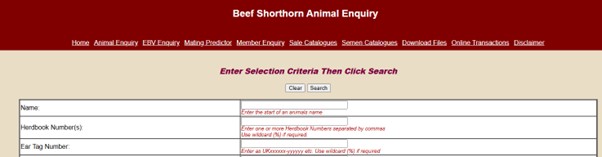
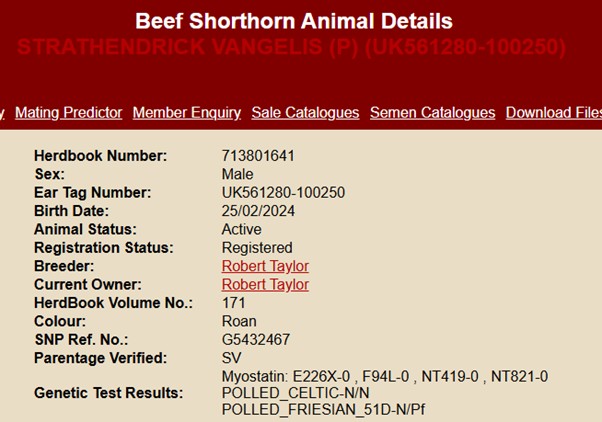
By clicking on the highlighted hyperlink, the animal’s details will then display, and polling results are under the section ‘Genetic Test Results’.
The example below is a Heterozygous Polled animal which is carrying 1 gene from Friesian origin and so will be typed on the certificate as
POLLED_CELTIC N/N (i.e a non carrier/no polled gene from Celtic origin)
POLLED_FRIESIAN 51D-N/PF (i.e. carrying one copy of a polled gene from Friesian origin)
How do I get my Beef Shorthorn tested for Polled status?
If your Beef Shorthorn does not have a Polled status displayed on our database, it is possible to request for DNA testing to be carried out to do this.
Please contact services@beefshorthorn.org to request a DNA sample bag or for this additional testing to be carried out on an animal that already has a 50K SNP/G number already.
For testing costs click here
https://www.beefshorthorn.org/the-society/fees-renewals/
For more information on how to collect a DNA sample click here


